

One of my biggest challenges in writing is setting, and as part of that, world building. In my early stories, I barely mentioned setting at all. I remember reading Donald Maass’ book that discussed “telling details”–believe it was his workbook—and thought I could never do that. I didn’t even understand how to get there.
I took an online writing class on how to do it. Very eye opening. I started seeing improvements right away. However, the writer/influencer lectured me that I should let my subconscious naturally add those details in. I knew that if I followed that advice, I’d still have no setting in my stories (conspiratorial whisper: I did not tell the instructor I hit setting with a battering ram.).
Been eleven years, and that has not changed. I’ve gotten better at getting it into the story, but I sometimes have to research elements before I write, then add them after I’ve finished writing them. Even when I have them in advance, they still don’t jump into the story. Five senses? I’m always leaving them out.
Enter AI.
It rightfully gets a bad rap from writers. When it was originally populated with data, the programmers grabbed everything without asking. But then, businesses have been doing that since the internet started. I read in a business book that the goal of businesses is to get 100% of all data.
Data is information. Data is money. That’s the reality.
I steered clear of it for a long time because of all the initial bad press. But after I heard Jason Alexander speak about AI at Superstars, it made me think, and I started playing with it.
The first thing to remember about AI is that it’s programmed to be helpful. It will always give you an answer, even if it’s a wrong answer. It’s also only as good as the information that is available.
For example…
I was wrestling with meal planning. Thanks to my combination of strengths, it’s skill that’s another planet away. So, I asked AI to generate a meal plan with about 130 grams of protein a day. Told AI this was two servings.
AI generated a list of meals for me, and the numbers were way off. It stated that it had fit everything to the macros. But the plan included an eight-ounce serving of protein per meal. There’s little information online for solo plans, so AI took four servings and made it fit.
Don’t trust “factual” information and double-check everything.
Second, not everything is available online. I just put down a book because the author believed everything could be found online. Her characters handily jumped online and dug out research on family lines from the 1700s in about five minutes. I’ve done genealogy. While there are sites with records uploaded, we’re still limited by what people recorded. The information is sometimes wrong, hard to read, misspelled, or nonexistent. We have a relative who did not exist before he got married. We think he might have changed his name (rumor after his mother booted him out of the house), but we don’t know if that’s true or if it is, what the name is.
AI can help you with getting through some of the information, but it does not replace the writer knowing how the information works.
Where AI shines, though, is helping you with brainstorming. Like with setting.
Alrighty…
I’m a big-picture thinker and visual-spatial. You’d think that the visual-spatial part means that I would put too much description in my stories. Instead, the combination of those two elements makes it challenging for me to break description into “telling details.”
I’ll take a walk on Theodore Roosevelt Island (making the effort to be specific!). Dirt walking paths, lots of trees. Someone else would identify the various trees as oaks, maples, sycamores. Me? I look at the trees, and I see…trees.
Referring to a master list I made for a short story, someone else would see the mountain laurel, witch hazel, and poison ivy as the understory. Me? A lot of plants growing on the ground.
Every one of us has something different that doesn’t quite work the same as everyone else. Peggy mentioned she needed a floor plan of a house to visualize an interior setting.
I usually need some kind of map, which I hand-draw:
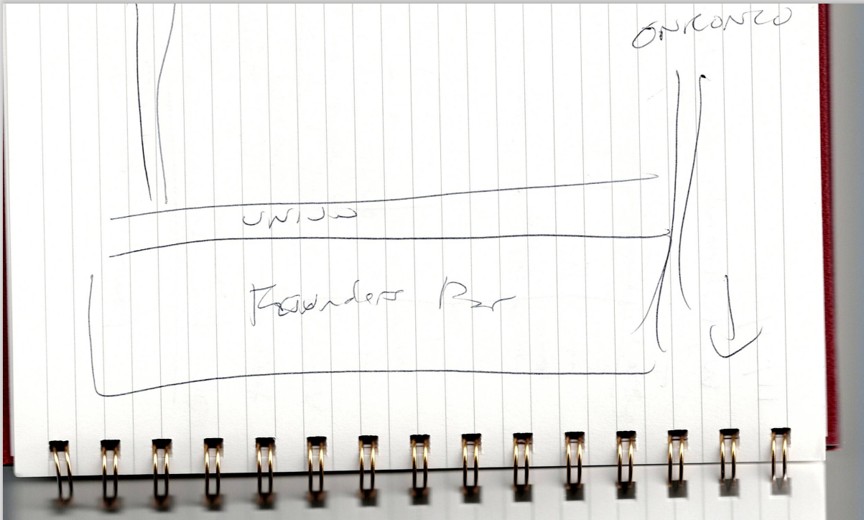
I also often need to see the place. But AI turned out to be a useful tool.
My main character Beckett Cain has a mentor that he meets with. Where did this guy live? Decisions, decisions. The story is urban fantasy, set in Washington, DC. I picked a place I’d found by wandering, Lake Barcroft. Maybe Beckett could live there, too. If I’m going to write fiction, I might as well pick a place that I would enjoy.
I drove out there to have a look. Lake Barcroft is a private lake for residents of the area only. The houses were built around it. What surprised me was that it didn’t look like the other housing areas in DC. Nearly everything is now dominated by a combination of big box, ugly houses and those gigantic apartment complexes with grocery stores. Everything is very sanitized.
These houses were all different. Some big box houses that were clearly added later, but a lot more houses that I thought might be post-World War II. One-story houses with carports—you don’t see many carports here anymore. Everyone’s got two-car garages and a driveway with a third car in it.
Wandered back to ask Copilot:
Beckett lives at Lake Barcroft, Falls Church, VA. What kinds of older house types would there be? I’m looking at a [one] story house, not remodeled. Maybe a carport.
It responded with a list of the types of houses there (mid‑century single‑story ramblers, split‑levels, and brick ranches from the 1950s–1960s). That gave me a detail of terminology that I didn’t have in my brain. I saw houses. I saw houses with garages. I saw houses with carports.
AI, being ever helpful, spit out a suggestion for Beckett’s house (a rambler because I wanted a one-story house). Then it asked if it could give me a floor plan. The floor plan was in text, which was helpful for me.
Then, as I’m writing a scene set there, in October at dusk, I was having trouble with the five senses. Curse those five senses!
AI prompt:
Beckett and Ray are standing outside on a two-lane street in Lake Barcroft, near the lake. The sun has set. Ray has his Golden Retriever Princess with him. But I’m having trouble with the five senses for the scene. Suggestions for what I might use?
The AI is pulling from my saved history, so it knows this is early October (though I’m surprised I didn’t include that in the prompt). It provided 3-5 things for each sense, including the sound of crickets chirping. Gibbs head smack. I know that. I like listening to the crickets with a bit of sadness because summer is ending. As I was writing, it never occurred to me to use crickets. Nor did it occur to me on a moving edit pass.
Sometimes, we all need a little help. AI doesn’t replace me as a writer. It helps nudge me towards details I would completely miss and continue to learn about fiction writing.
 Linda Maye Adams
Interesting about the details. That could be helpful.
LikeLike