
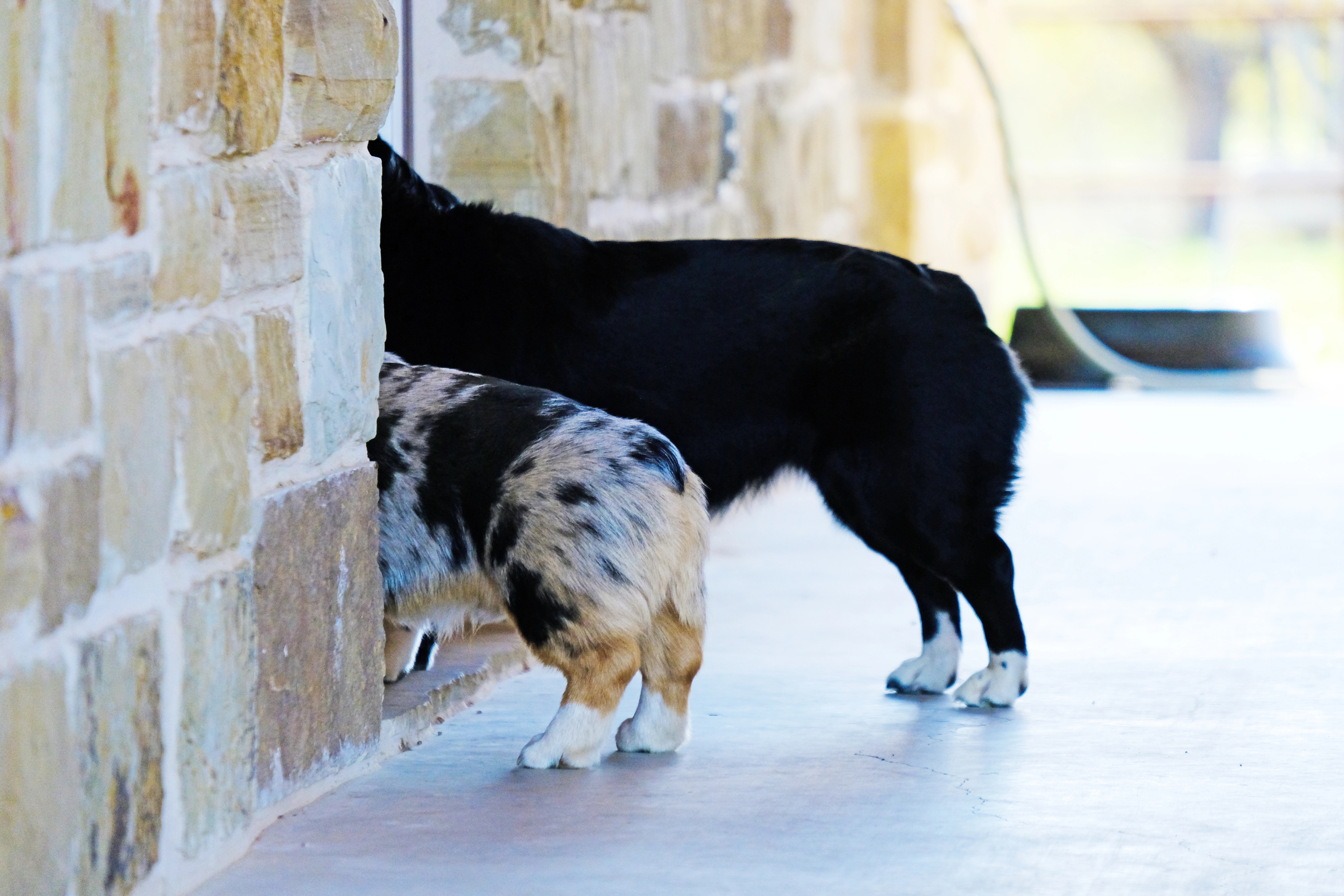
Corgi butts on dogs in doorway of home / Deposit Photos. I found this image by searching on “dog doorway.”
Especially after writing a short story a week for a year, I’ve concluded that the opening of any story—short or a novel—is the foundation supporting the entire work. The reader needs to be grounded into the story, not thrown into it like tossing someone into a swimming pool. Without that grounding, it’s easy for the reader to put down the book and not pick it up again.
Without the foundation, plot takes on too much of the load.
It’s an area of craft that is both discussed a lot and not discussed well. People describe it with step-by-step instructions, and it’s not a one size fits all. The result is quite confusing. Just look at this article from Bookbub. I was exhausted reading this.
I’ve always had trouble figuring out how to start a story. Much of the advice available says, “Begin with an outline” or assumes that without telling you. The advice also assumes none of it is coming naturally into your story.
So I asked a well-known pantser, “How do you tell where to start the story?” He merely pointed to the advice he’d already given: character + problem + setting. Others recommend: Read, read, read. But my brain fires up like a pinball machine. Sometimes it doesn’t go in the “proper order.” Sometimes I’m missing the slingshot to launch me to the next step. (Input alert: The Anatomy of a Pinball Machine).
Consequently, I still didn’t know exactly where I should start the story or what I might be missing or have too much of.
This has been my goal for the Beckett Cain Urban Fantasy. Using The Plot Module as a basis for my structure has been eye-opening, helped along because I read a book where I could see the formula in the opening.
Of course, I still started in the wrong place. But I kept looking at this other book and thinking about it, and I started in a different place. I had to ask myself questions like:
- What’s going to show the main character’s occupation and be something easily resolved in the first chapter? (He’s a private investigator)
- What’s going to show the main character’s magic and how it works? So, whatever crime-type thing in the first chapter also had something to do with magic. It’s urban fantasy, so that must be established immediately. But it also takes the heavy lifting off making story events at the same time.
- Where was I going to set this scene? I already had the bigger setting—Washington, DC. Who does urban fantasy set in DC? No one!
Setting is the biggest influence of these and has been the most troublesome for me. It’s a challenging craft skill to learn because it’s connected to so many things. Yet, it’s always played down as not being that important. I ran across a traditionally published book that advocated not bothering with the setting at all!
What setting actually does
Establishes your genre
You don’t need to be writing speculative fiction for this to affect your story. If you’re writing a cozy mystery, you must show the reader the small town setting. Or if the story is a noir mystery, you must show the gritty underbelly of a big city like Las Vegas. A local writer offered a class on researching history in the DC area for fiction. Three books published. I read the samples. If I had not known from the blurb that they were set during a specific period, I would not have known they were historical. Setting is part of every genre, and every scene.
Uses foreshadowing
I took an Autocrit class on this topic and realized I should do a little more. Since the character is about to get into a tough situation, having an October storm spitting rain sounds like great foreshadowing. You don’t get this kind of use unless you think about the location, the time of year, and the weather. Piling on top of that, Dave Farland talks not just about having rain, but what it feels like.
Vehicle for character emotions
We’ve all seen writers online trying to figure out how to show anger, usually by waving a fist. A character can slam a knife down on a cutting board in a kitchen. Or it can show up as how they describe something in the setting, like fiery red. But you kind of need to have the setting. There’s a series I’m still reading, set in a secondary world of Ancient Egypt in modern times. The author clearly is an expert on Ancient Egypt and yet doesn’t have enough of the world to make the character emotions ring.
Grounding setting in time and place
C.S Lankin’s blog talks about being more deliberate with the setting. Pretty much, it can become a generic detail all too easily, especially if little thought is given to it. I read—and stopped reading—another book where the character entered a cafeteria-style restaurant. Someone must have told her she needed to describe the location, so she added details like four top tables and a tray conveyor belt.
Boring! It’s not like we can’t steal details from other places we’ve been. Add a fountain. Or pull in your world and what your character is doing. Think about what time of the year it is—very few books do this. Think about the weather. It’s 30 in DC with windchill that puts us at 20. We had a meeting at work, and everyone talked about how cold it was in their areas. How would the cold impact magic? Since we’re now headed into Christmas, how does the upcoming holiday impact the story? I always laugh at NCIS when they talk about getting from the Washington Navy Yard to Quantico in 30 minutes. It’s 37 miles. Add the ugly Christmas shopping traffic…
Perhaps we think too much that the opening is setting up the plot (story events), not about setting up the things that lead to the plot: the character, his job (because that’s usually a part of the story), the place where he lives, and the world itself.
The opening isn’t the start of the plot; it’s an entrance into the story itself and lets the reader step inside.
 Linda Maye Adams